 العربية
 English

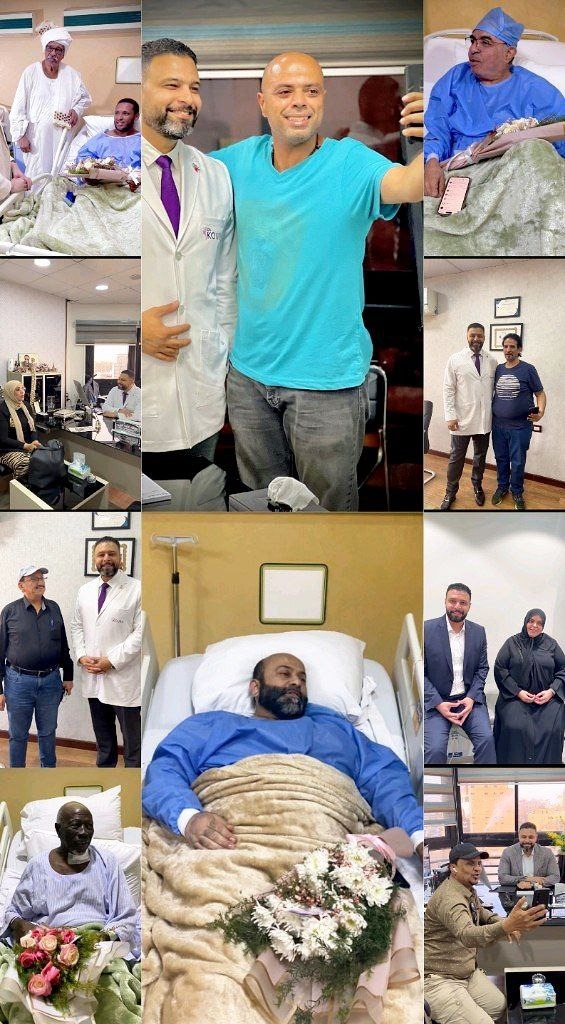
To see patients' reviews
Click hereBack Pain Radiating Down the Leg: Is It Sciatica or Something Else?
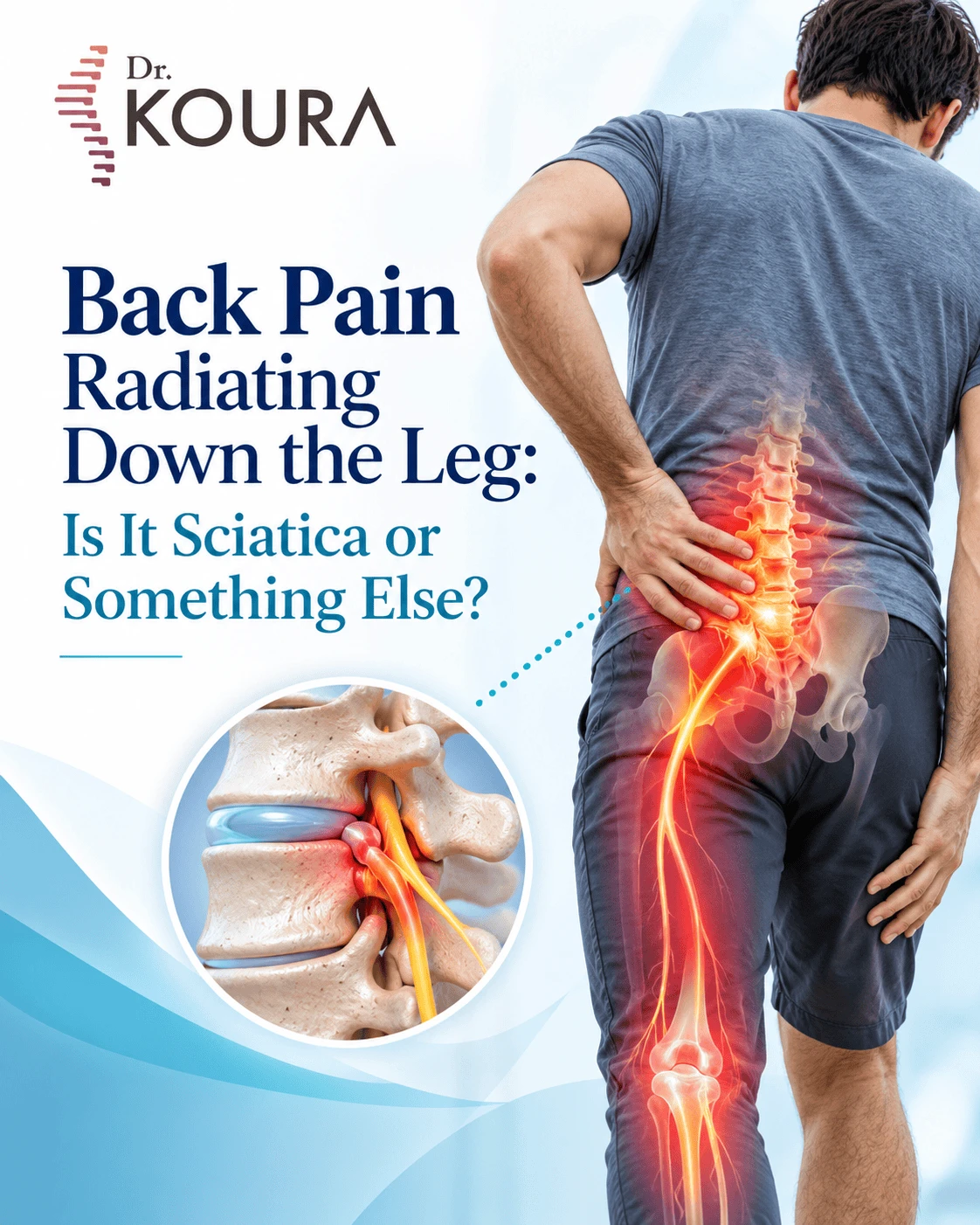
Back Pain Radiating Down the Leg: Is It Sciatica or Something Else?
If pain starts in your lower back and travels into your buttock, thigh or leg—especially when it is accompanied by tingling, numbness, burning or electric-shock-like pain—it may be sciatica.
But not every pain that travels down the leg is sciatica, and not every disc herniation requires surgery.
Dr. Mohamed Koura, Consultant in Pain Medicine in Egypt and Specialist in Pain Medicine in Dubai, focuses on diagnosing the source of spinal pain and selecting the most appropriate treatment pathway for each patient.
His practice includes conservative management when appropriate, as well as image-guided and minimally invasive interventional pain procedures for carefully selected patients.
The goal is not to choose a procedure before making the diagnosis.
It is to identify where the pain is coming from, which nerve or spinal structure is involved, and whether an intervention is suitable at all.
Dr. Koura sees patients in Cairo and Dubai and also evaluates international patients who travel specifically for specialist assessment and, when appropriate, an interventional pain procedure.
Does Back Pain That Travels Down the Leg Always Mean Sciatica?
No.
Sciatica describes a pattern of symptoms usually caused by irritation or compression of the nerve roots that contribute to the sciatic nerve.
Pain may begin in the lower back and travel through the buttock, thigh and lower leg, sometimes reaching the foot.
It may be associated with:
- Tingling or numbness in the leg or foot.
- Burning or electric-shock-like pain.
- Pain that increases with certain movements or prolonged sitting.
- Altered sensation in part of the leg.
- Weakness in certain muscles in more significant cases.
However, similar symptoms can result from more than one condition.
That is why careful clinical assessment should come before choosing treatment.
What Can Cause Lower Back Pain That Radiates Into the Leg?
1. Lumbar Disc Herniation
A lumbar disc herniation is one of the common causes of pain that travels from the lower back into the leg.
A portion of the disc may irritate or compress a nerve root, causing pain, numbness, tingling or burning along the pathway of the affected nerve.
However, an important point is:
An radiological scans showing a disc bulge or herniation does not automatically prove that the disc is the cause of the patient's pain.
Disc changes are also found in some people who do not have the same symptoms.
Imaging therefore needs to match the clinical examination, the distribution of the pain and any neurological findings before treatment is selected.
2. Nerve-Root Inflammation or Irritation
A nerve does not always need to be severely compressed to become painful.
Inflammation or irritation around a nerve root may also cause radiating pain, burning, tingling or altered sensation.
3. Lumbar Spinal Stenosis
Lumbar spinal canal stenosis is narrowing of the spaces through which the nerves pass within the spine.
Some patients develop:
- Pain or numbness in one or both legs.
- Heaviness or weakness while walking.
- Increasing symptoms after standing or walking for a certain distance.
- Improvement when sitting or bending forward.
Treatment depends on the degree of narrowing, the neurological examination, functional limitations, previous treatment and the patient's overall condition.
4. Other Conditions That Can Mimic Sciatica
Not every pain that starts in the lower back or buttock and travels toward the leg comes from a disc.
Lumbosacral Facet-joint pain, sacroiliac-joint problems and other musculoskeletal causes can sometimes produce overlapping symptoms.
Treating an radiological finding instead of identifying the true pain source can result in the wrong treatment target.
When Does Back and Leg Pain Need Urgent Assessment?
Most episodes of back pain or sciatica are not medical emergencies.
However, urgent medical assessment is important if you develop:
- New or rapidly worsening weakness in the leg.
- Loss of bladder or bowel control.
- Numbness or loss of sensation around the saddle area.
- Rapidly progressive neurological symptoms.
These features may indicate significant nerve compression and should not be delayed while trying routine pain treatments.
Does Sciatica Require Surgery?
Majority of patients with sciatica may not need any surgery
Treatment depends on the cause, the severity and duration of symptoms, neurological findings and the response to previous treatment.
Some patients improve with appropriate conservative management.
Many patients are candidates for a targeted interventional pain procedure.
When there is severe neurological compromise or another clear surgical indication, a spine-surgical assessment should not be postponed simply to avoid surgery.
The aim is the right treatment for the right patient — not avoiding surgery at any cost.
Minimally Invasive Treatment Options for Sciatica and Disc-Related Pain
Interventional pain medicine offers several minimally invasive treatment options for selected patients with sciatica, disc-related pain or nerve-root irritation.
No single procedure is suitable for everyone.
Dr. Koura considers:
- The suspected source of pain.
- The involved nerve root.
- The shape and location of any disc herniation.
- The degree of nerve compression.
- Radiological scans findings.
- Neurological examination.
- Duration of symptoms.
- Previous treatment.
- Any previous spinal surgery.
The procedure is then selected according to the diagnosis rather than simply choosing the most advanced technique available.
Selective Nerve-Root Injection
When a specific nerve root appears to be inflamed or irritated, an image-guided selective nerve-root injection may be considered.
Medication is delivered to a defined anatomical target around the affected nerve rather than being given as a general intramuscular pain injection.
These procedures may have therapeutic and, in selected cases, diagnostic value.
However, they are not automatically the correct treatment for every disc herniation or every case of sciatica.
Radiofrequency Procedures
Radiofrequency is a group of interventional pain techniques used to target selected nerves or pain pathways in specific conditions.
The type of radiofrequency procedure and the target depend on the suspected pain source.
A proper diagnosis therefore comes before deciding whether radiofrequency has a role.
Advanced Epidural Catheter Procedures
In selected patients with more complex radicular pain, spinal stenosis or epidural adhesions, a steerable or targeted catheter may be introduced into the epidural space to reach a specific area around an affected nerve root.
A catheter-based procedure is different from a routine epidural injection.
It may help the physician reach areas that are more difficult to target using a standard needle technique.
These procedures require detailed knowledge of spinal anatomy and experience in guiding a catheter within a confined area close to neural structures.
Epidural Balloon Techniques
In selected cases, a small balloon catheter may be used as part of an epidural intervention to work within narrowed or adhered areas of the epidural space.
Balloon procedures are not the same as a standard injection and are not the same as epiduroscopy.
Patient selection is particularly important because spinal stenosis has different patterns and severities, and not every patient is suitable for this approach.
These techniques have a significant technical learning curve because they involve precise catheter navigation close to nerve roots.
Epiduroscopy
Epiduroscopy is an advanced interventional pain procedure in which a small endoscope is introduced into the epidural space.
It allows direct visualization of parts of the epidural space and may be considered in selected patients with persistent spinal or radicular pain.
This may include some patients who continue to experience pain after previous back surgery or who have suspected epidural scarring and adhesions around nerve roots.
In appropriate cases, epiduroscopy may allow targeted treatment of adhesions and more precise delivery of treatment to the affected area.
However:
Epiduroscopy is not appropriate for every patient with back pain, and it should not be described as a risk-free procedure.
It is technically demanding and requires specialist training, experience and careful patient selection.
percutaneous laser disc decompression(PLDD)
Laser may be used in selected minimally invasive disc procedures when the disc pathology and clinical presentation make the patient suitable for this type of treatment.
It is important to distinguish laser disc decompression treatment from:
- Epiduroscopy.
- Epidural catheter procedures.
- Balloon catheter techniques.
- Disc-FX.
These are separate procedures with different indications.
A patient who is suitable for one of these techniques is not automatically suitable for another.
Disc-FX for Selected Disc Herniations
Disc-FX is a minimally invasive intradiscal procedure intended for selected disc pathology.
Through a percutaneous access route, dedicated instruments are used to treat disc tissue believed to be contributing to the patient's symptoms.
Disc-FX is not an automatic alternative to surgery and is not suitable for every herniated disc.
Appropriate selection depends on:
- The type of disc herniation.
- Its size and location.
- Its relationship to the affected nerve root.
- The patient's symptoms.
- Neurological findings.
- Previous treatment.
For advanced intradiscal procedures, careful patient selection is as important as the technical procedure itself.
What If Pain Continues After Disc Surgery or Other Spine Surgery?
Some patients continue to experience pain, or develop recurrent pain, after previous spine surgery.
This is sometimes described as Failed Back Surgery Syndrome, although the term Persistent Spinal Pain Syndrome is also used in modern pain medicine for some of these presentations.
This does not necessarily mean that the operation itself "failed," and it does not describe one single problem.
Persistent or recurrent symptoms may be related to:
- Epidural scarring or adhesions.
- Residual or recurrent nerve compression.
- Disease at another spinal level.
- A change in the source of the pain.
- Other causes that require further investigation.
The first step is therefore not automatically repeating surgery or choosing an interventional procedure.
It is to identify why the pain has persisted or returned.
Can Persistent Pain After Back Surgery Be Treated Without Another Operation?
For selected patients, there may be interventional options after the cause of the pain has been investigated.
Depending on the diagnosis, these may include:
- Targeted nerve-root procedures.
- Epidural catheter techniques.
- Adhesiolysis procedures.
- Epiduroscopy.
- Selected radiofrequency procedures.
For other patients, conservative treatment, rehabilitation, medication optimisation or renewed surgical assessment may be more appropriate.
The treatment pathway should follow the diagnosis.
Why Technical Experience Matters in Advanced Spine Interventions
Advanced interventional spine procedures are not simply "back injections."
There is a major difference between:
- Placing medication around a nerve root.
- Navigating a catheter inside the epidural space.
- Working around postoperative adhesions.
- Performing epiduroscopy.
- Treating the disc itself using an intradiscal procedure such as Disc-FX.
Some of these techniques have a demanding technical learning curve.
They require careful access planning.
- Experience in managing complex spinal anatomy.
- Careful patient selection.
Experience therefore does not only mean being able to perform the procedure.
It also means knowing when not to perform it.
About Dr. Mohamed Koura
Dr. Mohamed Koura is a Consultant in Pain Medicine in Egypt and Specialist in Pain Medicine in Dubai, with a particular focus on interventional pain management and minimally invasive spine procedures.
His international professional qualifications include:
Fellowship in Interventional Pain Practice (FIPP)
World Institute of Pain
and:
European Diploma in Pain Medicine (EDPM)
European Pain Federation – EFIC
alongside academic qualifications in anaesthesia, intensive care and pain medicine.
His spine practice includes image-guided needle procedures as well as more advanced catheter-based, endoscopic and intradiscal interventions for appropriately selected patients.
The principle is straightforward:
Diagnose first. Then choose the least invasive treatment that appropriately addresses the problem — if an intervention is needed at all.
Sciatica and Lower Back Pain Assessment in Dubai
If you live in Dubai or elsewhere in the UAE and have lower-back pain travelling into the leg, persistent sciatica, numbness, burning or a diagnosed disc herniation that has not improved as expected, you can arrange an assessment with Dr. Mohamed Koura in Dubai.
The consultation focuses on your symptoms, neurological examination, available scans and previous treatments.
The aim is to determine whether you need:
- Conservative care.
- An image-guided injection.
- A more advanced interventional procedure.
- Or assessment by another specialty, including spine surgery when indicated.
Having access to several interventional techniques does not mean the most advanced procedure is always the best one.
The preferred option is the simplest appropriate treatment for the diagnosed problem.
Sciatica and Disc-Related Pain Assessment in Cairo
Dr. Mohamed Koura also evaluates patients in Cairo and Giza, including Mohandeseen and Sheikh Zayed, for:
- Lower-back pain.
- Sciatica.
- Disc herniation.
- Nerve-root pain.
- Lumbar spinal stenosis.
- Selected cases of persistent pain after previous spine surgery.
The treatment plan is based on the history, clinical examination, imaging and response to previous treatment rather than on one scan finding alone.
International Patients Travelling for Assessment or Treatment
Dr. Koura's clinics also receive international patients who travel to Cairo or Dubai for specialist assessment and, when appropriate, an interventional pain procedure.
Patients from nearby countries including Saudi Arabia, Kuwait, Qatar, Bahrain, Libya and Iran may contact the clinic before travelling to ask what reports and imaging should be available for review.
Travelling for treatment should not begin with choosing a procedure by name.
The priority is to establish whether the diagnosis, symptoms and imaging make that procedure appropriate.
Frequently Asked Questions
Is Every Pain That Travels From the Back Into the Leg Sciatica?
No.
Sciatica is one possible cause, but disc herniation, spinal stenosis, nerve-root irritation and several musculoskeletal conditions can produce similar symptoms.
Diagnosis depends on the patient's history, clinical examination and imaging when required.
Does a Herniated Disc Always Require Surgery?
No.
Many disc herniations do not require surgery.
Other cases do need surgical assessment, particularly when there is significant or progressive neurological compromise.
The decision should be based on the patient's symptoms and neurological examination, not the MRI alone.
Can Sciatica Be Treated With an Injection?
Selected patients may benefit from an image-guided nerve-root or epidural injection, depending on the pain source and clinical findings.
An injection is not automatically the correct treatment for every patient with sciatica.
Does Radiofrequency Treat Every Type of Sciatica?
No.
Radiofrequency has specific indications and targets.
The pain generator and relevant nerve pathway must be identified before deciding whether a radiofrequency procedure has a role.
Is Disc-FX Suitable for Every Slipped or Herniated Disc?
No.
Disc-FX is intended for selected disc pathology.
Suitability depends on disc morphology, location, neurological findings, symptoms and previous treatment.
What Is the Difference Between an Epidural Catheter and Epiduroscopy?
An epidural catheter is navigated within the epidural space to reach a defined treatment area.
Epiduroscopy uses a small endoscope to directly visualise parts of the epidural space.
They may have overlapping goals in selected patients, but they are not the same procedure.
Can Pain After Previous Back Surgery Be Treated Without Another Operation?
Sometimes.
Selected patients may have interventional options such as targeted injections, catheter-based treatment, adhesiolysis, epiduroscopy or other pain procedures.
The appropriate treatment depends first on understanding why the pain has persisted or returned.
Back Pain Travelling Down Your Leg? Start With the Diagnosis, Not the Procedure
If lower-back pain travels into your buttock or leg, or you have persistent sciatica, numbness, burning or leg pain despite previous treatment, the most important next step is to understand the source of the problem.
Your treatment may be conservative.
You may benefit from a targeted intervention.
A more advanced technique may be appropriate in a carefully selected case — and in some situations, a surgical opinion may be the right next step.
Book Your Assessment with Dr. Mohamed Koura
You can visit Dr. Mohamed Koura for a specialist assessment and to discuss the treatment options most appropriate for your condition at our clinics in Egypt or Dubai.
If you live outside Egypt or Dubai, an Online Consultation is also available to review your condition, medical reports and available imaging, and to discuss the next steps before arranging travel when needed.
Egypt | Dubai | Online Consultation
Book your appointment or contact our clinic team to find the most suitable consultation option for you.
Why Choose Dr. Mohamed Koura ?
Simply because he is the best doctor in his feild. He stays updated on the latest treatment technologies through his participation in various international conferences with leading foreign doctors and experts. Finally, and most importantly, Dr. Mohamed Koura is the best doctor in Egypt and the Arab world, possessing 12 non-surgical techniques for treating spinal and joint problems. He was the first to introduce modern interventional treatment techniques in Egypt & the Middle East and is the only one using the disc fx technique to treat spinal pain.
No, it is necessary to make a reservation through a phone call or social media messages.
Lower back pain can result from several causes, including a herniated disc, nerve compression, muscle strain, or chronic spinal injuries. Lifestyle factors such as prolonged sitting, muscle weakness, and excess weight can also exacerbate the problem.
Yes, most cases can be successfully managed with non-surgical treatment for lower back pain. Options such as medication, nerve root injection, disc injection, and radiofrequency therapy are highly effective in relieving pain and improving mobility without the need for surgery.
The best treatment for back pain depends on the cause and severity of the condition. Typically, it starts with medication for back pain, followed by minimally invasive procedures like nerve root injections or radiofrequency therapy to target the source of pain effectively.
Yes, radiofrequency therapy is considered a safe and effective option for chronic lower back pain. It works by interrupting pain signals from the affected nerves and provides long-lasting relief, especially in cases of herniated disc and spinal pain.
A life without pain without surgery
Once you book with Dr. Koura
Get rid of pain with just one call… Book your appointment now with Dr. Mohamed Koura, the best pain management doctor and a specialized consultant in spine treatment.
The highest success rates thanks to years of experience and scientific development
Using the latest non-surgical technologies available in Egypt and the Middle East
The largest team specialized in treating spine and joint pain without surgery

































Services
Our Branches
- Egypt - El Mohandssen
- +201210577770
- 54, intersection of Al-Batal Ahmed Abdel Aziz Street with the League of Arab States, above Qatar National Bank - Mohandiseen - Giza
- Al Sheikh Zayed
- 00201067303035
- ، First Al Sheikh Zayed, Giza Governorate
- Dubai
- +971501232065
- Dubai Healthcare City Phase 2 - Al Jaddaf - Dubai - United Arab Emirates