 العربية
 English

To see patients' reviews
Click hereCervical Disc Herniation Treatment Without Surgery | Dr. Koura
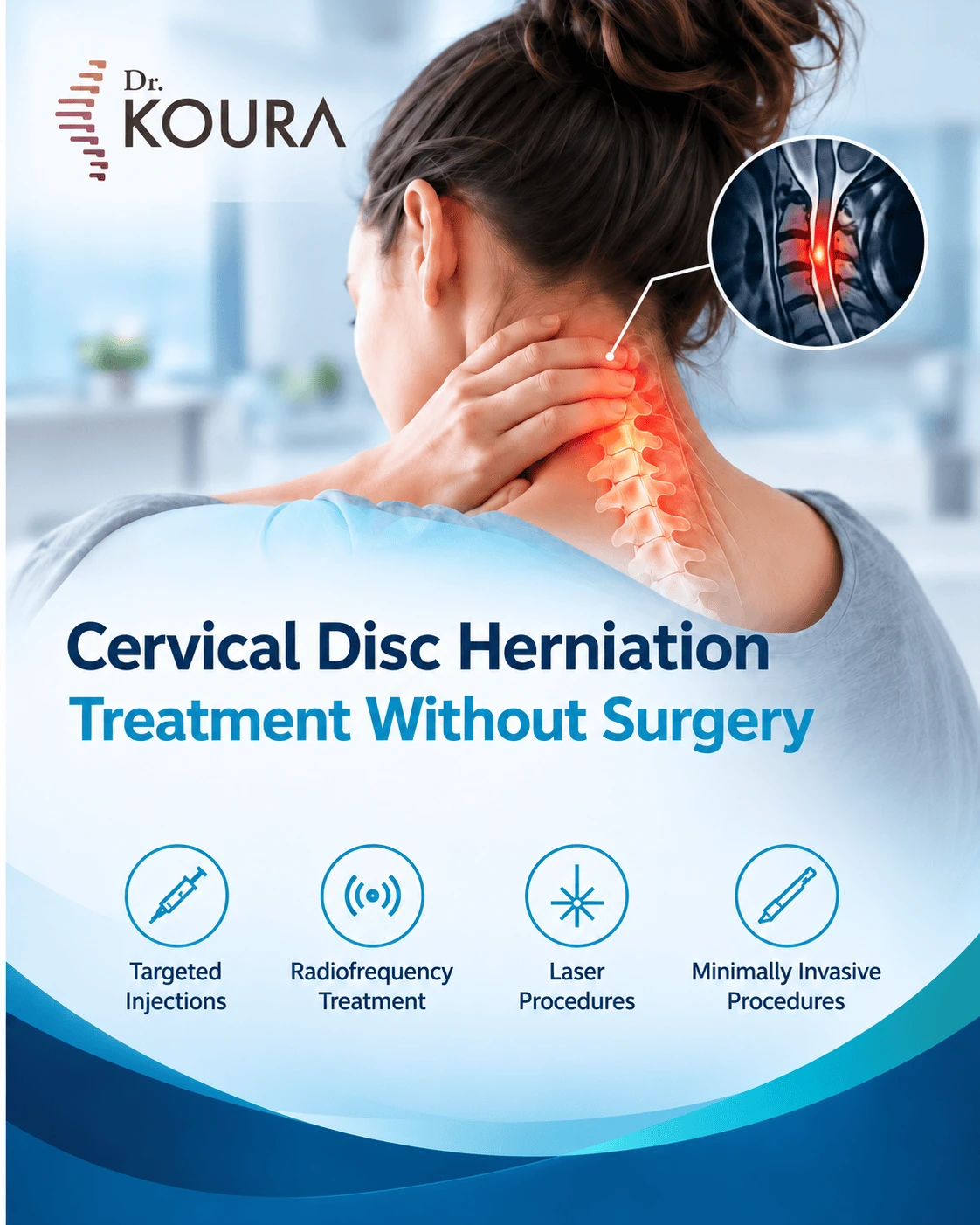
Cervical Disc Herniation Treatment Without Surgery
Persistent neck pain, pain spreading into the shoulder or arm, numbness, tingling, or weakness should not simply be treated as “ordinary neck pain.” In some patients, these symptoms may be related to a cervical disc herniation or irritation of a cervical nerve root.
At Dr. Koura Pain Management & Spine Clinics, patients are assessed individually to determine whether their symptoms are actually coming from a cervical disc, a nerve root, the facet joints, or another structure in the neck.
Dr. Mohamed Koura, Consultant in Pain Medicine in Egypt and Specialist in Pain Medicine in Dubai, focuses on advanced interventional pain management and minimally invasive procedures for spinal and joint pain. With more than 17 years of experience and international qualifications including the FIPP Fellowship in Interventional Pain Practice and the European Diploma in Pain Medicine (EDPM), Dr. Koura treats patients in Cairo and Dubai, including international patients who travel specifically for specialist assessment and interventional pain procedures.
The objective is not to perform the most advanced procedure simply because it is available. The objective is to identify the source of pain and select the least invasive appropriate treatment for the individual patient.
What Is a Cervical Disc Herniation?
The cervical spine is the part of the spinal column located in the neck. Between the cervical vertebrae are discs that act as cushions and allow movement between the bones.
A cervical disc herniation occurs when material from inside a disc pushes through a weakened or damaged outer portion of the disc. If the displaced disc material irritates or compresses a nearby nerve root, it can produce symptoms beyond the neck itself.
Cervical disc herniation is sometimes referred to as a cervical slipped disc, cervical disc prolapse, or cervical herniated disc.
However, not every disc bulge seen on an MRI is the cause of pain. Some disc changes are found in people who have no symptoms at all.
That is why treatment should be based on the combination of:
- Your symptoms
- Neurological examination
- MRI or other appropriate imaging
- The location and size of the disc problem
- The relationship between the imaging findings and your symptoms
- Your previous treatments and their results
What Are the Symptoms of Cervical Disc Herniation?
Symptoms vary depending on which cervical structures and nerves are affected.
Common symptoms may include:
- Persistent neck pain
- Pain extending from the neck into the shoulder
- Pain traveling down the arm
- Tingling or “pins and needles”
- Numbness in the arm or hand
- Weakness in the arm or hand
- Reduced neck movement
- Pain aggravated by certain neck positions or movements
A cervical disc problem can therefore present as much more than neck pain.
For example, a patient may primarily complain of arm pain or numbness while the underlying source is a cervical nerve root being irritated.
Cervical Disc Herniation vs. Cervical Disc Degeneration
Cervical disc degeneration and cervical disc herniation are related but not identical.
With age, the discs may gradually lose some of their normal structure and hydration. This can contribute to cervical spondylosis and other degenerative changes.
A disc may also bulge or herniate and potentially irritate a nerve.
Importantly, an abnormal finding on radiological imaging does not, in itself, constitute an indication for an invasive diagnostic or therapeutic intervention; management should be guided by the nature of the abnormality, clinical examination correlation, and the overall assessment of risks and benefits.
The most appropriate treatment depends on whether the imaging findings actually explain the patient's symptoms.
How Is Cervical Disc Herniation Diagnosed?
A specialist assessment usually begins with a detailed medical history and neurological examination.
Depending on the presentation, imaging may include:
MRI
MRI is particularly useful for evaluating cervical discs, nerve roots, and the degree of disc or other structural compression.
X-ray
X-rays can provide information about alignment, degenerative changes, and other structural abnormalities.
CT Scan
In selected situations, CT may provide additional information about the bony structures of the cervical spine.
The goal is not simply to find an abnormality on an image. It is to determine what is actually generating the patient's pain and neurological symptoms.
Can Cervical Disc Herniation Be Treated Without Surgery?
In many patients, yes.
The treatment pathway depends on the severity of the symptoms, neurological findings, imaging results, and response to conservative treatment.
Depending on the diagnosis, treatment may include:
- Medication when appropriate
- Activity and posture modification
- Physical rehabilitation
- Targeted therapeutic injections
- Cervical nerve-root procedures
- Radiofrequency procedures for selected pain generators
- Percutaneous laser procedures for carefully selected disc conditions
- Selected minimally invasive disc procedures
However, not every cervical disc herniation is suitable for an interventional procedure, and not every patient should avoid surgery.
If there is significant or progressive neurological compromise, spinal cord involvement, severe weakness, or another indication for surgical management, referral for surgical assessment may be necessary.
Advanced Interventional Treatment for Cervical Disc Herniation
One of the main advantages of an interventional pain-management approach is that treatment can be directed toward the specific anatomical source of pain.
At Dr. Koura Clinics, the available techniques include several advanced minimally invasive options. The decision to proceed with an intervention should be guided by an individualized, evidence-based assessment of the clinical presentation, radiological findings, and risk–benefit profile, rather than by a uniform approach applied to all patients.
1. Cervical Nerve Root Injections
When symptoms are related to inflammation or irritation around a cervical nerve root, a targeted injection may be considered.
The medication is delivered close to the affected nerve under imaging guidance.
The potential goals include:
- Reducing inflammation
- Relieving radiating arm pain
- Reducing nerve-root irritation
- Helping the patient regain movement and function
A nerve-root injection is not the same as treating every type of neck pain. It is most useful when the clinical findings indicate that a specific nerve root is involved.
2. Cervical Radiofrequency Procedures
Radiofrequency treatment can be used for selected cervical pain conditions.
Importantly, radiofrequency is not one single procedure for every type of neck pain.
Depending on the diagnosis, radiofrequency may target pain-generating structures such as the cervical facet joints or selected cervical nerve roots.
It can therefore have a role in patients with certain facet-mediated neck pain conditions and in selected cases involving cervical nerve-related pain.
The exact target must be determined clinically and anatomically.
3. Percutaneous Laser Disc Decompression
Dr. Koura’s clinical practice includes percutaneous laser disc decompression for the management of selected cases of small contained cervical intervertebral disc herniations.
The technique uses a needle to access the disc, with controlled energy applied to the disc material.
The intended purpose is to reduce the volume or pressure within the disc and potentially decrease irritation of the nearby nerve.
This is a technically demanding procedure and is not appropriate for every cervical disc herniation.
Patient selection is particularly important in the cervical spine because of the sensitive anatomy surrounding the treatment area.
4. Minimally Invasive Disc-FX
Disc-FX is a minimally invasive disc procedure that uses a specialized system to access and treat selected herniated disc material through a small percutaneous access route rather than an open surgical incision.
Dr. Koura's current website specifically describes Disc-FX among his advanced techniques and also lists its use in selected cervical disc herniation cases.
Because cervical disc procedures require particularly careful anatomical assessment, Disc-FX application in the management of cervical disc herniation should be individualized, with careful patient selection based on clinical presentation, radiological findings, and the overall suitability of the procedure.
The decision depends on factors such as:
- The type of disc herniation
- Its location
- The degree of nerve compression
- MRI findings
- Neurological examination
- Previous treatment
- Whether the disc pathology is technically suitable for the procedure
The aim is to provide a minimally invasive option for appropriately selected patients—not to suggest that every patient with a cervical disc problem requires Disc-FX.
Why Advanced Cervical Procedures Require Experience
A small needle does not necessarily mean a simple procedure.
Some interventional pain procedures involve structures that are only millimeters away from nerves, blood vessels, the spinal cord, or other critical anatomy.
Advanced procedures therefore require:
- Detailed anatomical knowledge and an understanding of relevant anatomical variations.
- Consultant-level clinical judgment and expertise, evident in Dr. Koura’s approach to patient assessment and procedural decision-making.
- Advanced procedural expertise and technical dexterity, including precise needle advancement and positioning, controlled instrument handling, and the technical skills required for the safe and accurate execution of complex image-guided interventions, as relevant to Dr. Koura’s clinical practice.
- Appropriate patient selection based on clinical indications, radiological findings, and individual risk factors.
- Accurate image-guidance techniques to facilitate precise needle placement and minimize the risk of injury to adjacent structures.
- Specialized technical training in relevant interventional procedures.
- Procedural experience and equipment proficiency, including familiarity with technical limitations and potential complications.
- Recognition of contraindications and clinical limitations to determine when a procedure may be inappropriate.
This is particularly important when patients are searching for alternatives to spinal surgery.
The question should not simply be:
“Can this procedure be done without surgery?”
The more important question is:
“Is this procedure appropriate for my particular condition?”
Epiduroscopy and Advanced Epidural Catheter Techniques
Dr. Koura's expertise extends beyond cervical disc treatment.
He also performs advanced interventional procedures for complex spinal pain, including epiduroscopy and catheter-based epidural procedures.
These techniques should be understood as different procedures rather than one automatically combined treatment.
Epiduroscopy
Epiduroscopy is a minimally invasive endoscopic procedure that enables direct visualization of the epidural space and structures surrounding the spinal nerve roots.
It may be considered in selected patients with persistent spinal pain following previous spinal surgery, particularly when epidural fibrosis or adhesions are suspected of contributing to ongoing symptoms.
The term Persistent Spinal Pain Syndrome (PSPS) is increasingly used in place of the historical term Failed Back Surgery Syndrome (FBSS), although terminology may vary across clinical contexts.
In appropriately selected patients, epiduroscopy may facilitate the identification and targeted mechanical disruption of epidural adhesions, potentially alleviating nerve root tethering without the need for repeat open spinal surgery.
Dr. Koura’s clinical practice in this field may be described in the context of the specialized expertise required for epiduroscopy, including detailed anatomical knowledge, appropriate patient selection, advanced endoscopic skills
Advanced Epidural Catheter Procedures
Catheter-based epidural procedures use a thin catheter to reach a targeted area within or around the epidural space.
Depending on the patient's condition and the specific technique, the catheter may be used to deliver medication or address adhesions and areas contributing to nerve irritation.
Certain advanced catheter systems may incorporate specialized steering, navigation, or balloon-based components.
Balloon techniques should not be described as automatically part of every epidural catheter procedure. Their use depends on the particular technique, anatomy, and clinical indication.
Persistent Pain After Back Surgery
Some patients continue to experience significant pain after spinal surgery.
This may occur because of several possible factors, including:
- Epidural scar tissue or adhesions
- Recurrent disc herniation
- Persistent nerve irritation
- Spinal stenosis
- Facet-joint pain
- Changes in spinal mechanics
- Another pain generator that was not the original source of pain
A second operation is not automatically the best answer.
In selected patients, advanced catheter procedures, epiduroscopy, targeted injections, radiofrequency procedures, or other minimally invasive interventions may be considered after careful evaluation.
Dr. Koura's clinics have a particular focus on interventional treatment for complex spinal pain and persistent pain following spinal surgery.
Treatment Beyond the Cervical Spine
The key advantage of an interventional pain-management practice lies in its ability to deliver diagnosis-driven treatment, targeting the specific underlying source of pain rather than treating pain as a single, uniform condition.
Dr. Koura's practice also covers:
Lower Back Pain and Sciatica
Minimally invasive options may include targeted nerve-root injections, radiofrequency procedures, catheter-based techniques, laser procedures, Disc-FX, and epiduroscopy in appropriately selected cases.
The appropriate procedure depends on whether the pain is caused by disc herniation, nerve inflammation, facet-joint pain, spinal stenosis, adhesions, or another condition.
Knee Osteoarthritis
For selected patients with knee osteoarthritis, interventional options may include radiofrequency treatment and therapeutic injections, including PRP in appropriate cases.
The goal is to reduce pain and improve function while considering the severity of joint degeneration and the patient's overall condition.
Shoulder and Hip Pain
Dr. Koura's practice also provides interventional treatment options for selected patients with shoulder and hip joint pain.
Treatment may include targeted injections and other minimally invasive pain-management procedures depending on the underlying diagnosis.
Trigeminal Neuralgia
Trigeminal neuralgia can produce severe, electric-shock-like facial pain.
For selected patients, radiofrequency treatment targeting the trigeminal pain pathway may provide a minimally invasive alternative to open surgical procedures.
Proper diagnosis and imaging are important before treatment because facial pain can have several different causes.
Cluster Headache
Cluster headache is a severe neurological pain disorder characterized by attacks of intense one-sided head or eye pain, often accompanied by autonomic symptoms such as tearing, eye redness, or nasal congestion.
For carefully selected patients with difficult-to-control cluster headache, interventional techniques—including radiofrequency procedures targeting appropriate neural structures—may be considered as part of specialist pain management.
These treatments are not appropriate for every patient with headache, and diagnosis should be established before an intervention is considered.
Palmar and Plantar Hyperhidrosis
Dr. Koura's practice also offers radiofrequency-based treatment for selected patients with excessive sweating of the hands and feet.
This is different from an endoscopic sympathectomy.
Radiofrequency treatment is an interventional approach that targets selected sympathetic nerve pathways using a needle-based technique, whereas endoscopic sympathectomy is a surgical procedure involving interruption of sympathetic nerves through an endoscopic operation.
The two approaches should therefore not be presented as the same treatment.
A Broad Range of Interventional Options
Dr. Koura's website states that his center provides 12 non-surgical treatment methods for spinal and joint conditions.
The publicly listed advanced techniques include:
- Radiofrequency treatment
- Epiduroscopy / sacral canal endoscopy
- Minimally invasive Disc-FX
- Navigator or epidural catheter procedures
- Targeted nerve-root injections
- Percutaneous laser procedures
- Mini-endoscopic procedures
- Claudicare-type spinal canal decompression techniques
- Therapeutic injections
- Botox treatment for selected indications
- Joint pain interventions
- Specialized interventions for selected headache and nerve-pain conditions
Because the exact combination of techniques offered can depend on the patient's diagnosis and the indication, the final treatment plan should always be determined following specialist assessment.
The value of having multiple interventional options is not simply the number of procedures.
It is the ability to choose the procedure that best matches the patient's anatomy, diagnosis, symptoms, imaging, and previous treatment history.
Why Patients From Outside Egypt Seek Assessment With Dr. Koura
Dr. Koura's clinics treat patients from Egypt and the UAE as well as international patients from a wide range of countries.
The practice reports treating patients representing more than 53 nationalities.
Some international patients travel specifically for specialist assessment or minimally invasive pain procedures after living with persistent spinal, joint, nerve, or headache pain.
For patients traveling from countries such as Saudi Arabia, Kuwait, Bahrain, Qatar, Libya, and Iran, the first step should be a detailed review of the medical history and available imaging to determine whether an in-person assessment and procedure are appropriate.
Patients do not need to assume that the most advanced procedre is automatically the best option.
The correct treatment is the one that matches the diagnosis.
Dr. Mohamed Koura in Cairo and Dubai
Dr. Mohamed Koura provides specialist pain-management services through his clinics in Cairo and Dubai.
Cairo
Patients can be assessed at the Dr. Koura clinic in Mohandessin, Giza, with additional services in Sheikh Zayed.
Dubai
Dr. Koura also sees patients in Dubai Healthcare City Phase 2, Al Jaddaf, Dubai, UAE.
For patients searching for a cervical disc herniation specialist in Dubai, neck pain treatment in Dubai, or advanced minimally invasive spine procedures in the UAE, the Dubai clinic provides access to Dr. Koura's interventional pain-management expertise.
Patients traveling from other countries can contact the clinic in advance to discuss their condition and provide relevant medical reports and imaging before arranging an appointment.
Is Cervical Disc Herniation Always Treatable Without Surgery?
No.
This is an important point.
Although many patients can improve with conservative or minimally invasive treatment, there are situations where surgery may be necessary.
Urgent medical assessment is particularly important if neck pain is associated with:
- Progressive weakness
- Significant loss of sensation
- Difficulty walking or problems with balance
- Symptoms suggesting spinal cord involvement
- Loss of bladder or bowel control
- Rapidly worsening neurological symptoms
The decision between conservative treatment, an interventional procedure, and surgery should be based on the patient's neurological examination, imaging, symptoms, and overall clinical condition.
Frequently Asked Questions
What is the best treatment for cervical disc herniation?
There is no single best treatment for every patient. Treatment depends on the location and severity of the disc problem, nerve involvement, symptoms, imaging findings, and response to previous treatment.
Can cervical disc herniation be treated without surgery?
Many patients can be managed without open surgery, using conservative treatment or selected minimally invasive interventions. However, some patients require surgical treatment, particularly when there is significant or progressive neurological compromise.
Can a cervical disc cause pain in the arm?
Yes. A cervical disc herniation can irritate or compress a cervical nerve root and cause pain, tingling, numbness, or weakness extending into the shoulder, arm, or hand.
Is Disc-FX suitable for every cervical disc herniation?
No. Disc-FX is a specialized minimally invasive procedure for selected disc conditions. Careful evaluation of MRI findings, symptoms, neurological status, and disc anatomy is required before deciding whether it is appropriate.
What is the difference between laser treatment and Disc-FX?
Percutaneous laser disc treatment uses controlled laser energy to vaporize a small amount of disc material, reducing intradiscal pressure in appropriately selected patients.
Disc-FX uses a specialized minimally invasive system to access the intervertebral disc and mechanically remove or treat targeted disc material, aiming to alleviate disc-related pain.
These procedures should not be considered interchangeable, as each has distinct technical characteristics, clinical indications, and patient-selection criteria. The choice of procedure should be guided by the underlying disc pathology, clinical presentation, and imaging findings.
Can neck pain be treated with radiofrequency?
Radiofrequency can be useful for selected causes of chronic neck pain, including certain facet-joint pain conditions and other appropriately diagnosed pain generators. The treatment target depends on the underlying diagnosis.
What is epiduroscopy used for?
Epiduroscopy allows direct visualization of the epidural space and can be particularly useful in selected patients with persistent spinal pain after surgery, especially when adhesions around nerve roots are suspected.
Do all patients with failed back surgery need another operation?
Not necessarily. Persistent pain after spinal surgery has several possible causes. After appropriate evaluation, some patients may be candidates for minimally invasive interventions such as catheter-based treatment or epiduroscopy.
Can international patients travel to Dr. Koura for treatment?
Yes. Dr. Koura's clinics treat international patients, and the practice reports patients from more than 53 nationalities. Patients traveling from countries such as Saudi Arabia, Kuwait, Qatar, Bahrain, Libya, and Iran can contact the clinic before travel to discuss their medical history and available imaging.
How do I know which procedure is right for me?
The correct procedure can only be determined after reviewing your symptoms, clinical examination findings, medical history, and imaging. Advanced procedures are not automatically appropriate simply because they are more technologically sophisticated.
Your Next Step
If persistent neck pain, arm pain, numbness, or weakness is affecting your daily life, the next step is not to choose a procedure from a list.
It is to determine what is causing your pain and whether an interventional treatment is appropriate for you.
Dr. Mohamed Koura provides specialist pain-management assessment in Cairo and Dubai, with expertise in advanced minimally invasive and interventional techniques for cervical disc problems and other complex spinal and joint pain conditions.
Book Your Assessment with Dr. Mohamed Koura
You can visit Dr. Mohamed Koura for a specialist assessment and to discuss the treatment options most appropriate for your condition at our clinics in Egypt or Dubai.
If you live outside Egypt or Dubai, an Online Consultation is also available to review your condition, medical reports and available imaging, and to discuss the next steps before arranging travel when needed.
Egypt | Dubai | Online Consultation
Book your appointment or contact our clinic team to find the most suitable consultation option for you.
Why Choose Dr. Mohamed Koura ?
Simply because he is the best doctor in his feild. He stays updated on the latest treatment technologies through his participation in various international conferences with leading foreign doctors and experts. Finally, and most importantly, Dr. Mohamed Koura is the best doctor in Egypt and the Arab world, possessing 12 non-surgical techniques for treating spinal and joint problems. He was the first to introduce modern interventional treatment techniques in Egypt & the Middle East and is the only one using the disc fx technique to treat spinal pain.
Persistent neck pain, stiffness during movement, headaches at the back of the head, or tingling and numbness in the shoulder or arm are all signs that may indicate the need for a proper medical evaluation.
تصلب الرقبة غالبًا نتيجة شد العضلات أو إجهاد الفقرات العنقية، وقد يزداد مع الجلوس لفترات طويلة أو النوم بوضعية خاطئة. العلاج يشمل تمارين تمدد الرقبة وبرامج تقوية العضلات.
Yes, compression of the cervical spine nerves can lead to pain, tingling, or numbness in the shoulder and arm. This condition can often be relieved through therapeutic injections or radiofrequency ablation, along with physical therapy.
Muscle strain pain is usually localized and worsens with movement or exertion, while a herniated disc may cause persistent pain, along with weakness in the arms. It requires a specialized evaluation to determine the most appropriate treatment.
Yes, interventional injections target the pain area directly and help reduce pressure on nerves and muscles, which decreases pain and improves mobility without surgery.
Treatment at Dr. Mohamed Koura Center includes therapeutic injections to relieve nerve pressure, radiofrequency ablation to reduce inflammation, as well as physical therapy exercises to strengthen neck muscles and improve flexibility.
Radiofrequency ablation helps relieve pressure on nerves and reduces inflammation, which effectively decreases pain. It is often combined with physical therapy programs to achieve the best results.
If the pain is accompanied by numbness or weakness in the hands or shoulder, difficulty moving, loss of muscle control, or sudden severe pain, medical attention should be sought immediately.
A life without pain without surgery
Once you book with Dr. Koura
Get rid of pain with just one call… Book your appointment now with Dr. Mohamed Koura, the best pain management doctor and a specialized consultant in spine treatment.
The highest success rates thanks to years of experience and scientific development
Using the latest non-surgical technologies available in Egypt and the Middle East
The largest team specialized in treating spine and joint pain without surgery

































Services
Our Branches
- Egypt - El Mohandssen
- +201210577770
- 54, intersection of Al-Batal Ahmed Abdel Aziz Street with the League of Arab States, above Qatar National Bank - Mohandiseen - Giza
- Al Sheikh Zayed
- 00201067303035
- ، First Al Sheikh Zayed, Giza Governorate
- Dubai
- +971501232065
- Dubai Healthcare City Phase 2 - Al Jaddaf - Dubai - United Arab Emirates